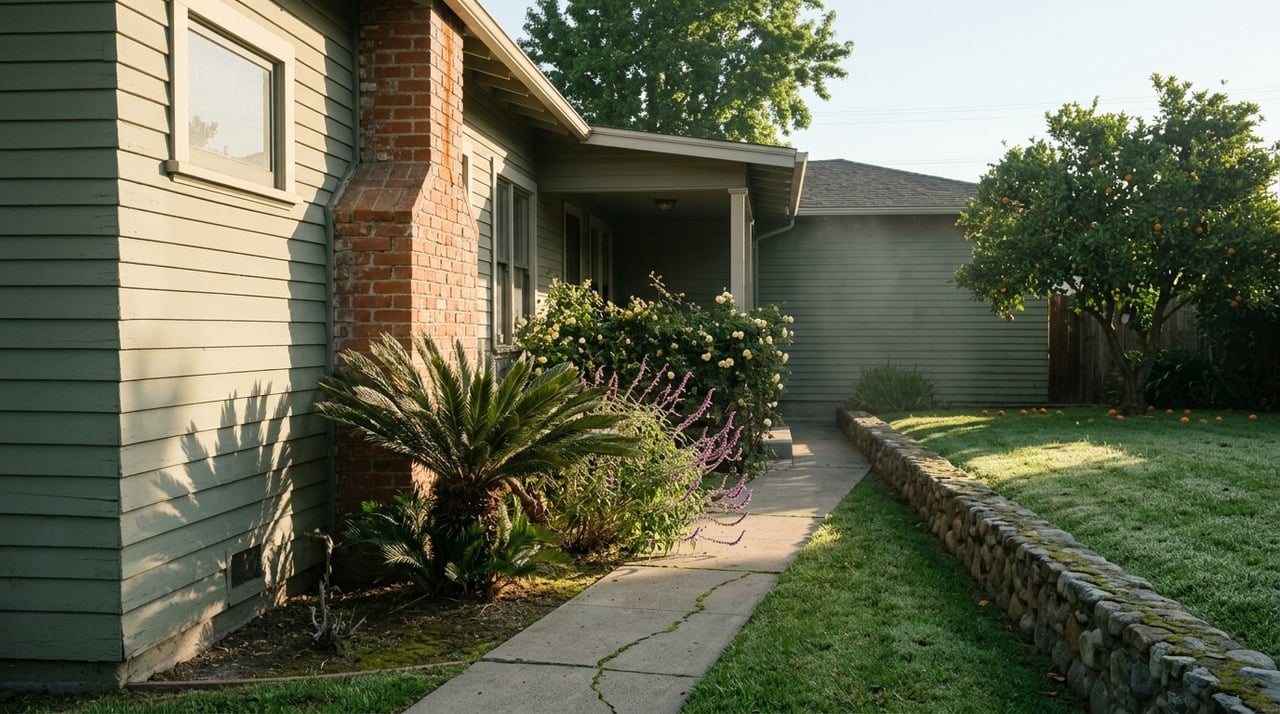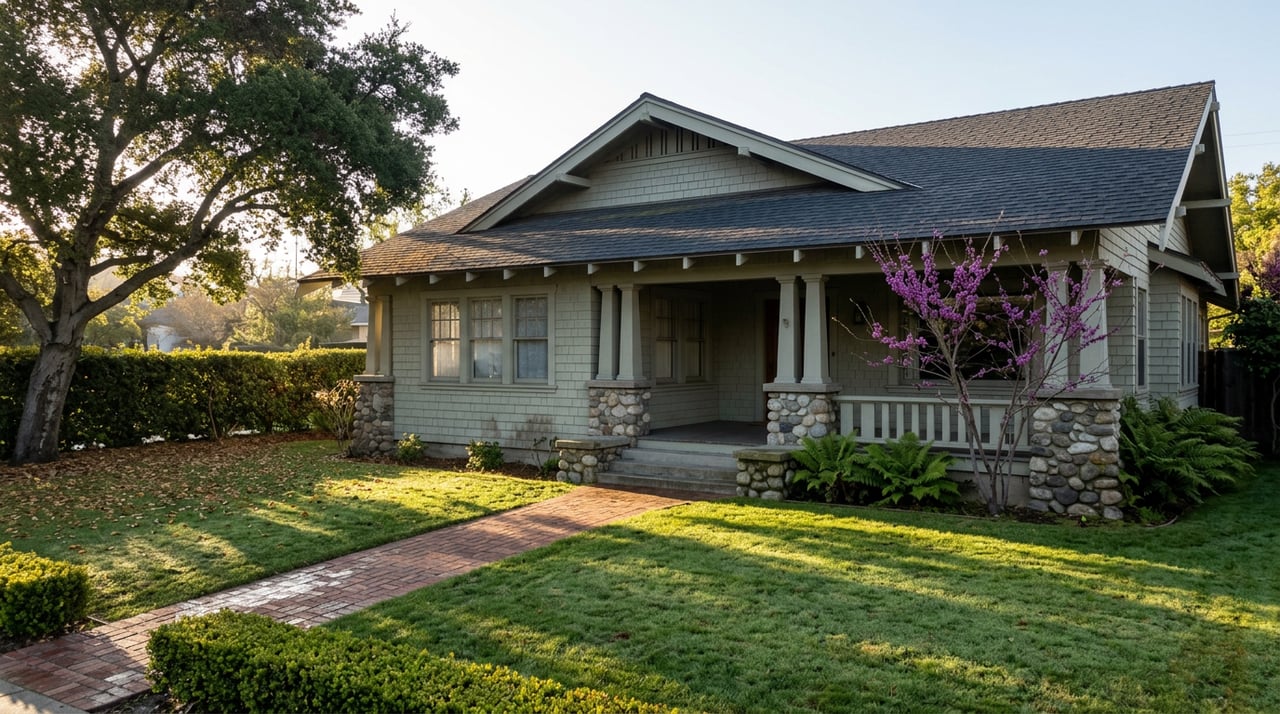
Walk the 300 block of Wildrose Avenue on a Saturday afternoon and you understand immediately why this stretch became Monrovia's first officially recognized historic district in 2008. Craftsman porches, mature street trees, roughly twenty homes carrying a century of continuous upkeep. What you cannot tell from the sidewalk is which of those homes actually pays a lower property tax bill because of that designation, and which ones do not. The two are not the same thing, and conflating them is the most common mistake buyers and sellers make when they hear the words "historic district" attached to a Monrovia address.
That confusion matters more here than in most of the San Gabriel Valley, because Monrovia has designated only two historic districts in three decades of preservation work. The rest of the city's character housing, hundreds of Craftsman bungalows, Spanish Revival cottages and Victorians scattered well outside those two small footprints, sits entirely outside district protection. If an owner of one of those homes wants the tax relief the Mills Act offers, the district system will not get them there. Something else has to.
District status and tax relief are two separate filings
Monrovia's Historic Preservation Commission, created when the city adopted its Historic Preservation Ordinance in 1995, administers two distinct categories of protection. A historic district gives every contributing property in its boundary a baseline of design review: exterior changes need a Certificate of Appropriateness, which protects the block's character but does nothing to a tax bill. A Mills Act contract is a separate ten-year renewable agreement between an individual property owner and the city, and it is the only mechanism that actually reduces the assessed value used to calculate property taxes, typically by 40 to 60 percent.
A home can sit inside a designated district and still owe full property tax, because its owner never filed for individual landmark status and never signed a Mills Act contract. A home can sit nowhere near either district and receive the same tax reduction, because its owner did the individual landmarking work on their own. District membership is a neighborhood-level protection. The tax benefit is a property-level contract. Buyers who assume the first guarantees the second are working from an incomplete picture, and it is the kind of gap that surfaces during escrow rather than during a walk-through.
What the two districts actually cover
Monrovia's historic preservation program has designated 169 individual landmarks since the city named its first one, the home at 231 N. Primrose Avenue, on June 4, 1996. Against that number, the district footprint is small.
| District | Designated | Footprint |
|---|---|---|
| Wild Rose Tract | 2008 | The 300 block of Wildrose Avenue, roughly 20 properties, 15 counted as contributing |
| North Encinitas | 2017 | The 100 and 200 blocks of North Encinitas Avenue |
That is the entire list. Everything else, the Upton Sinclair House on North Myrtle Avenue, The Oaks on North Primrose Avenue, the C.O. Monroe House on Monroe Place (built in 1884 and still the oldest standing structure in the city), earned its protection through individual landmarking, not district membership. If you are shopping the pre-war stock north of Foothill Boulevard, the odds that any particular home you like sits inside one of the two mapped districts are low. The odds that it could still qualify for a Mills Act contract, on its own merits, are much better, but only if someone does the paperwork.
What individual landmarking actually involves
The process is documented and consistent, whether the district exists around a property or not:
- The owner researches the property's history: construction date, architect or builder if known, and which of the city's designation criteria it meets.
- The owner files a Historic Landmark Application with Planning staff, along with a $500 filing fee and, if pursuing tax relief at the same time, an additional $780 for the Mills Act contract application.
- The Historic Preservation Commission reviews the application at a public meeting, takes testimony, and recommends approval, approval with corrections, or denial to the City Council.
- The City Council holds its own public hearing and makes the final call.
Landmark and Mills Act applications are processed together, so an owner does not have to landmark first and apply for the tax contract later. But the reverse assumption, that landmark status arrives automatically because a home looks the part or sits near a district, does not hold. Age alone is explicitly not sufficient under the city's own criteria.
The incentive stack, once you clear that step
Once a property is landmarked and under contract, the benefits are real and specific, not abstract goodwill:
- A property tax reduction typically between 40 and 60 percent of assessed value, running for a renewable ten-year term
- A 60 percent reduction in building permit fees for qualifying restoration work
- Setback flexibility for one-story additions
- Relief from non-conforming parking requirements
- A bed-and-breakfast use provision for owners who want that flexibility
- A 180-day hold on demolition permits for any pre-1940 structure, giving preservation advocates time to find alternatives before a teardown proceeds
An architectural historian who tracks Mills Act filings across the region put Monrovia's 2024 average participant savings at $5,183 a year. That is meaningfully smaller than the headline numbers thrown around in Pasadena, largely because Monrovia's home values run lower, and it is a useful reality check for anyone assuming the tax break alone justifies the landmarking effort. The bigger draw, for most owners who go through with it, is the permit fee reduction and the protection against a neighbor's incompatible remodel next door.
What landmark status does not guarantee: the Aztec Hotel
Nothing illustrates the limits of designation better than Monrovia's most visible landmark, the Aztec Hotel at 311 W. Foothill Boulevard. Designed by architect Robert Stacy-Judd and opened in 1925, its Mayan Revival facade made it one of the more architecturally unusual buildings on the entire Route 66 corridor, and it earned a spot on the National Register of Historic Places in 1978. That designation has never been in question.
What the designation could not do was keep the hotel open. It closed for renovations in 2012 and has sat vacant since. The Los Angeles Times took a fresh look at the building in June 2026, reporting that it remains for sale at an asking price of $15 million under current owner Kathie Reece. Vicky Hansen, a member of Monrovia's Historic Preservation Commission, told the Times the building could still be brought back if someone is willing to spend what it takes. That is the honest state of things fourteen years after closure: protected, documented, and still waiting for an economic path forward.
For a residential buyer, the lesson translates directly. Landmark status and a Mills Act contract are legal categories that protect a building's character and lower its carrying cost. They are not a business plan, and they do not substitute for an honest look at what a specific property needs and what it will cost to bring it there.
What this means if you are shopping character homes right now
As of August 2026, Monrovia's median list price sat just above $1 million, with typical listings spending a bit over six weeks on market. That is enough runway for a buyer to ask the right question before writing an offer: is this home individually landmarked, is it under an active Mills Act contract, and if the contract exists, does it transfer at sale (it does, automatically, since the agreement runs with the property rather than the owner). None of that shows up on a standard listing sheet. It shows up in the city's own landmark records and in the Community Development Department's Mills Act contract file, and it is worth confirming before the tax assumption becomes part of your offer math.
A short FAQ
Does buying a home in Monrovia's historic district automatically qualify me for the Mills Act? No. District status protects exterior character through design review. The tax reduction requires a separate individual landmark designation and a signed Mills Act contract on that specific property.
If a home already has a Mills Act contract, does it carry over when I buy it? Yes. The contract runs with the property, not the owner, and transfers to the new buyer at sale.
How long does individual landmarking take? It depends on the Historic Preservation Commission's meeting schedule and City Council calendar, but the process runs through a Commission hearing followed by a Council hearing, both public, both required regardless of whether the property sits inside an existing district.
If you are weighing a character home in Monrovia, whether it is a landmarked Craftsman on Wildrose Avenue or a pre-war bungalow that has never been through the process at all, The Sabatella Delair Group can walk you through exactly what a property's designation status does and does not include before you write an offer.