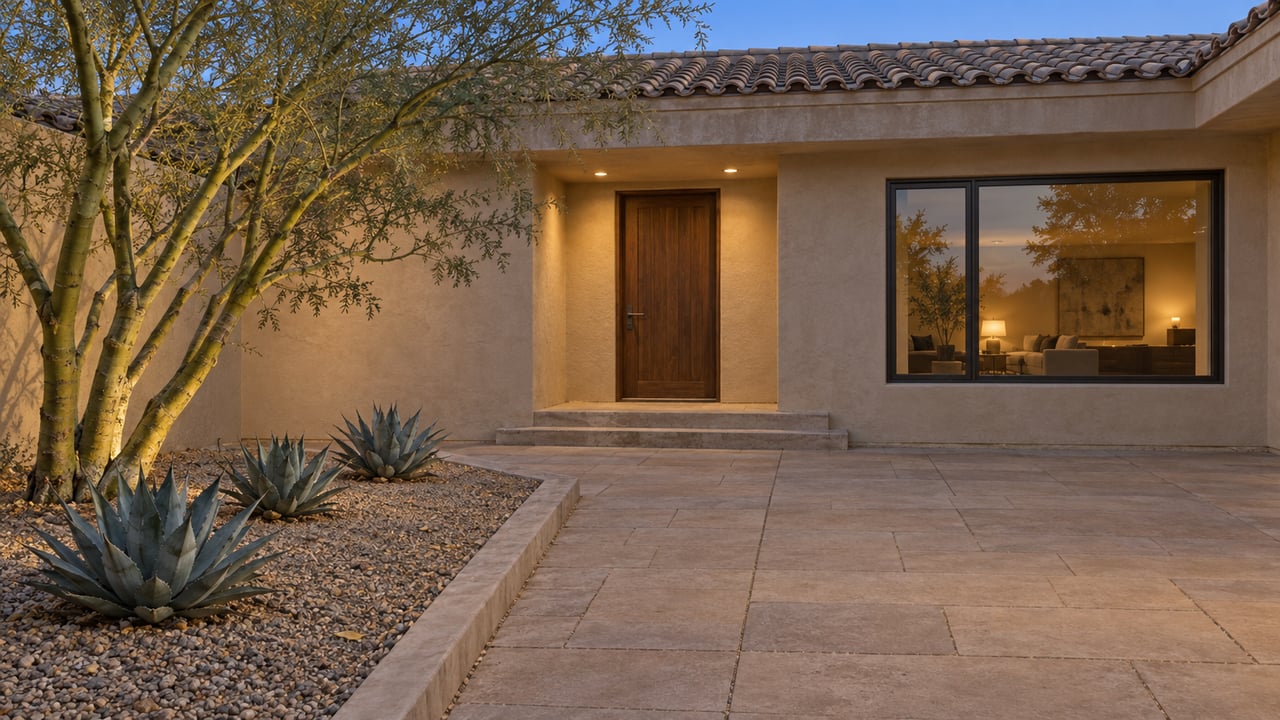
From the front patio of 366 South Orange Grove Boulevard you look across the street at the Wrigley Mansion, the home of the Tournament of Roses. The townhome is part of Chateau de Ville, a complex built in 1974. Its asking price this fall was $1,495,000 for about 1,971 square feet, according to Pasadena Now's November 2 feature. In October 2026 the median existing single-family house in Los Angeles County sold for $955,090.
So a two-bedroom townhome on this boulevard is asking more than half a million dollars above the typical county house. That makes sense once you know how the boulevard was rebuilt. Buyers here are paying for a street that was divided into units without changing its scale. Most of the condo's discount compared with a nearby house reflects the land each unit no longer comes with.
The boulevard was rezoned before it was rebuilt
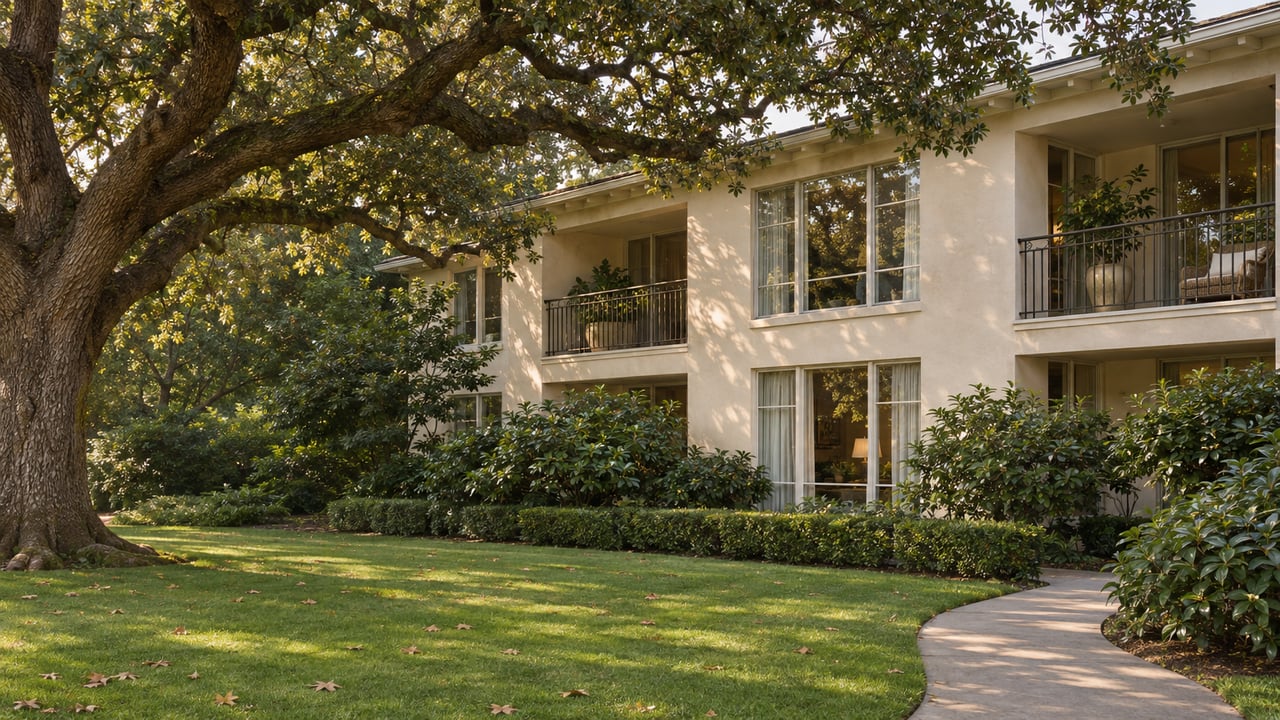
"Millionaires Row" became the name for South Orange Grove in the 1890s. The great estates numbered about a dozen, running along the Arroyo side of the street from Walnut Street to Columbia Street, according to the City of Pasadena's Historic Context Statement on residential development. Several of those houses were gone long before apartments were allowed. William Wrigley Jr. bought Henry C. Durand's 1895 house at 359 South Orange Grove in 1915 and tore it down to make his garden bigger. Thaddeus Lowe's 24,000-square-foot Shingle Style mansion at 955 South Orange Grove was finished in 1887. The Shedd family auctioned its contents in 1928, the city's records caption its demolition as 1929, and the subdivided front parcel later became the Orange Grove Circle Apartments.
The city rezoned South Orange Grove for multifamily housing in 1948. The city's history calls the construction that followed "slow and steady," and it continued into the 1980s. Houses kept coming down well after the rezoning. The William C. Stuart House at 1201 South Orange Grove, built in 1893, was demolished in 1960. The first Fényes house at 251 South Orange Grove, built in 1897, was gone by 1964.
The slow pace shaped the street. The city credits the boulevard's "strong sense of place" to the common setback, height, scale and massing of the new buildings, and says architecture had less to do with it. Those shared setbacks and that consistent scale are a large part of what a South Orange Grove unit sells.
Why so many of the buildings have French names
The developers knew what they were selling. The city's context statement lists the complexes and their dates:
| Complex | Address on S. Orange Grove Blvd. | Built |
|---|---|---|
| Cravens Court | 1111 | 1964 |
| Wynwood House | 727 | 1965 |
| The Trianon | 535 | 1965 |
| Chateau de Ville | 332 to 370 | 1974 |
| Chateau Fontaine | 801 to 813 | 1975 |
| One South Orange Grove | One | 1980 |
| The Belle Fontaine | 776 | 1982 |
Architect John Pugsley designed Cravens Court in a Neo French Provincial style as a direct reference to the Cravens Mansion, which still stands to its west. The city writes that the developers of the other complexes were "likely seeking to associate themselves with the mansions no longer extant." The Trianon, the chateaus and the fountains were names chosen to sell the estate era by the unit, and the 2026 asking prices suggest the approach still works.
The modern buildings are part of the street's history too. Julius Shulman photographed Orange Grove Village, and those photographs are now in the Getty Research Institute's archive. In 2016, Pasadena Heritage ran a South Orange Grove tour that followed the boulevard from its millionaires' mansions to its contemporary condos.
What this fall's asking prices show
Two units on the boulevard came to market in October and November 2026. Each has close to 2,000 square feet and a two-car garage.
The Ardmore House condo at 480 South Orange Grove, built in 1972, asked $1,595,000 in October. It is a single-level, ground-floor unit with 1,949 square feet, two bedrooms, two baths, two fireplaces and a wraparound patio, per Pasadena Now's October 13 feature. The Chateau de Ville townhome at 366 asked $1,495,000 in November. It has two bedrooms, three baths, a den on the bedroom level, a community pool and spa, and an attached two-car garage. Both figures are asking prices, and either home could close at a different number.
Statewide benchmarks give a sense of scale. The California Association of Realtors' October 2026 report puts the median condo or townhome in the state at $650,000 for October, unchanged from a year earlier. In the same month, statewide condo and townhome sales fell 17.6 percent year over year, and the median time on market was 38 days. At this fall's asking prices, the two Orange Grove units are listed at about 2.3 and 2.5 times that state median. Square footage accounts for some of the difference, since these units are about as large as a three-bedroom house. The rest of the premium comes from the boulevard.
County conditions shifted this fall. The Los Angeles County unsold inventory index reached 4.1 months in October 2026, compared with 3.3 months in October 2025, and the median single-family house sold in 31 days, compared with 33 days a year earlier. Those are countywide figures for houses, not a measure of this boulevard. They point to more homes for buyers to compare this fall, while the homes that sold went under contract a little faster than a year ago.
The gap between a unit and a house is mostly the land
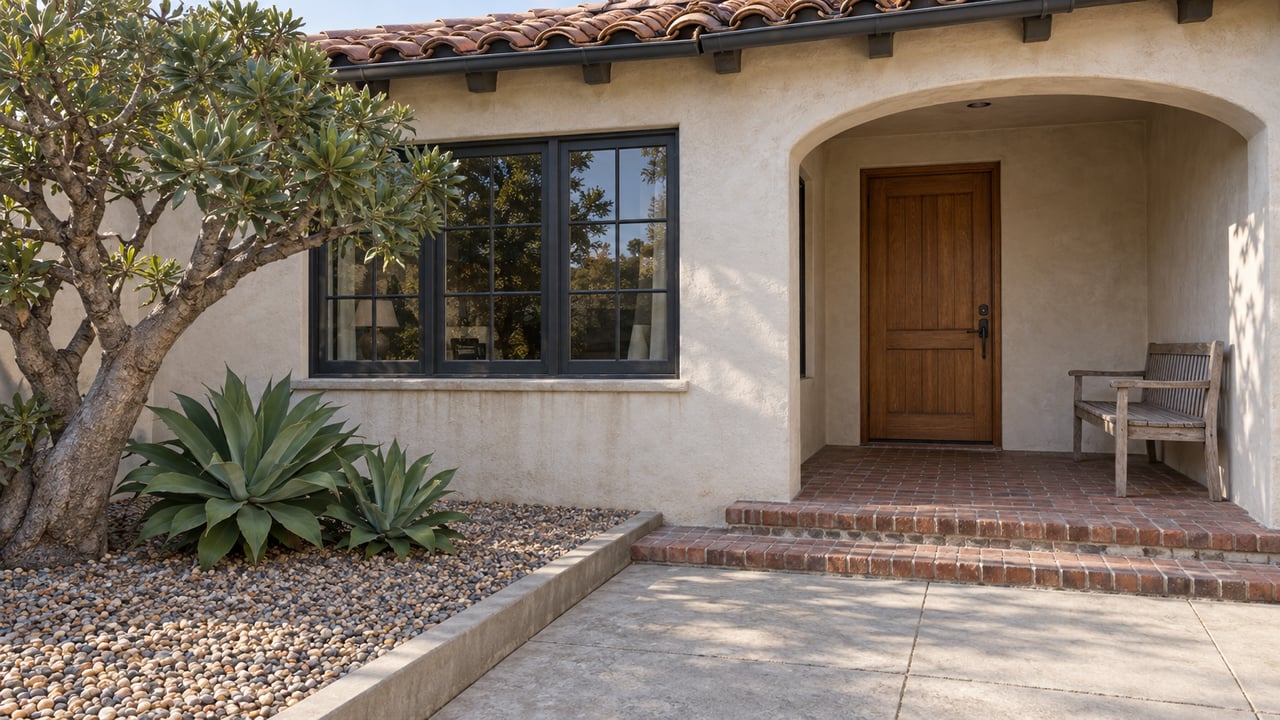
In Pasadena's South Arroyo neighborhood, a 1924 Spanish Colonial Revival at 430 La Loma Road came to market in September for the first time in 70 years. It has 1,722 square feet, three bedrooms and two baths, and sits on a 6,133-square-foot corner lot under two Laurel Fig trees, with fig and avocado trees in the back. Its asking price was $1,795,000, per Pasadena Now's September 23 feature.
That house has less interior space than either Orange Grove unit. It asked $200,000 more than the Ardmore House condo and $300,000 more than the Chateau de Ville townhome. By the square foot, the La Loma house asked about $1,042, Ardmore House about $818 and Chateau de Ville about $759.
So the condo saves a buyer roughly $200,000 to $300,000. In return the buyer gives up a lot they own outright, a garden, a corner and a 1924 house with a stone archway and a barrel-vaulted foyer. The buyer still gets the boulevard and its shared setbacks, a garage, more interior space, and in Chateau de Ville's case a shared pool. On this stretch of Pasadena the address keeps nearly all of its price. The land comes off the price tag. This is why a South Orange Grove unit should be compared with houses in the Arroyo neighborhoods. Comparing it with condos elsewhere in the city understates its price.
For a design-minded buyer, the eras matter as much as the price. The 1960s buildings, such as Cravens Court, The Trianon and Wynwood House, are period revival designs from the mid-century. Chateau de Ville and Chateau Fontaine are 1970s townhome complexes. One South Orange Grove and The Belle Fontaine are from the 1980s. Floor plans, parking and shared grounds differ by complex, so walking the grounds tells a buyer as much as walking the unit.
Living on the old Millionaire's Row
The surviving mansions are now public buildings. The Wrigley estate at 391 South Orange Grove was given to the city in 1958 and is the Tournament of Roses headquarters. The Pasadena Museum of History runs tours of the Fényes Mansion, a 1906 Beaux-Arts house designed by Robert Farquhar, with a 1911 addition by Sylvanus Marston. The neighbors in the condos have house museums down the street.
On January 1, 2027, the Rose Parade starts at Green Street and Orange Grove Boulevard, heads north on Orange Grove and turns east onto Colorado Boulevard. Farther west, Lower Arroyo Park at 415 South Arroyo Boulevard covers more than 70 acres from the Holly Street Bridge to the city's southern limit, with trails, a bridle path, an archery range and the casting pond. The Norton Simon Museum is at 411 West Colorado Boulevard, at the boulevard's north end.
A few questions buyers ask about the boulevard
Are the Orange Grove complexes old enough to count as historic? The oldest of the complexes the city names dates to 1964 and the newest to 1982. The city's own architectural history treats them as part of Pasadena's residential story, and Pasadena Heritage has toured them. For how a specific building is classified, check the city's records for that address.
How does Orange Grove fit with the rest of Pasadena's condo market? Our Pasadena condos and Pasadena townhomes pages show current inventory across the city. Orange Grove units are best judged against houses near the Arroyo, for the reasons above. Our Pasadena neighborhood guide covers the wider city.
Where can I read more about Pasadena's historic houses and their costs? We looked at how a house's historic status can affect what it costs to own in The Two Bungalows Problem.
If you are deciding between a unit on South Orange Grove and a house in the South Arroyo, Carmine and Ryan can walk both with you and tell you which Chateau, which era and which floor plan has held its value. If you already own on the boulevard, The Sabatella Group can show you how this fall's asking prices compare with your home's value. Work With Us.